Yhoshua Gutierrez
Stockton, California
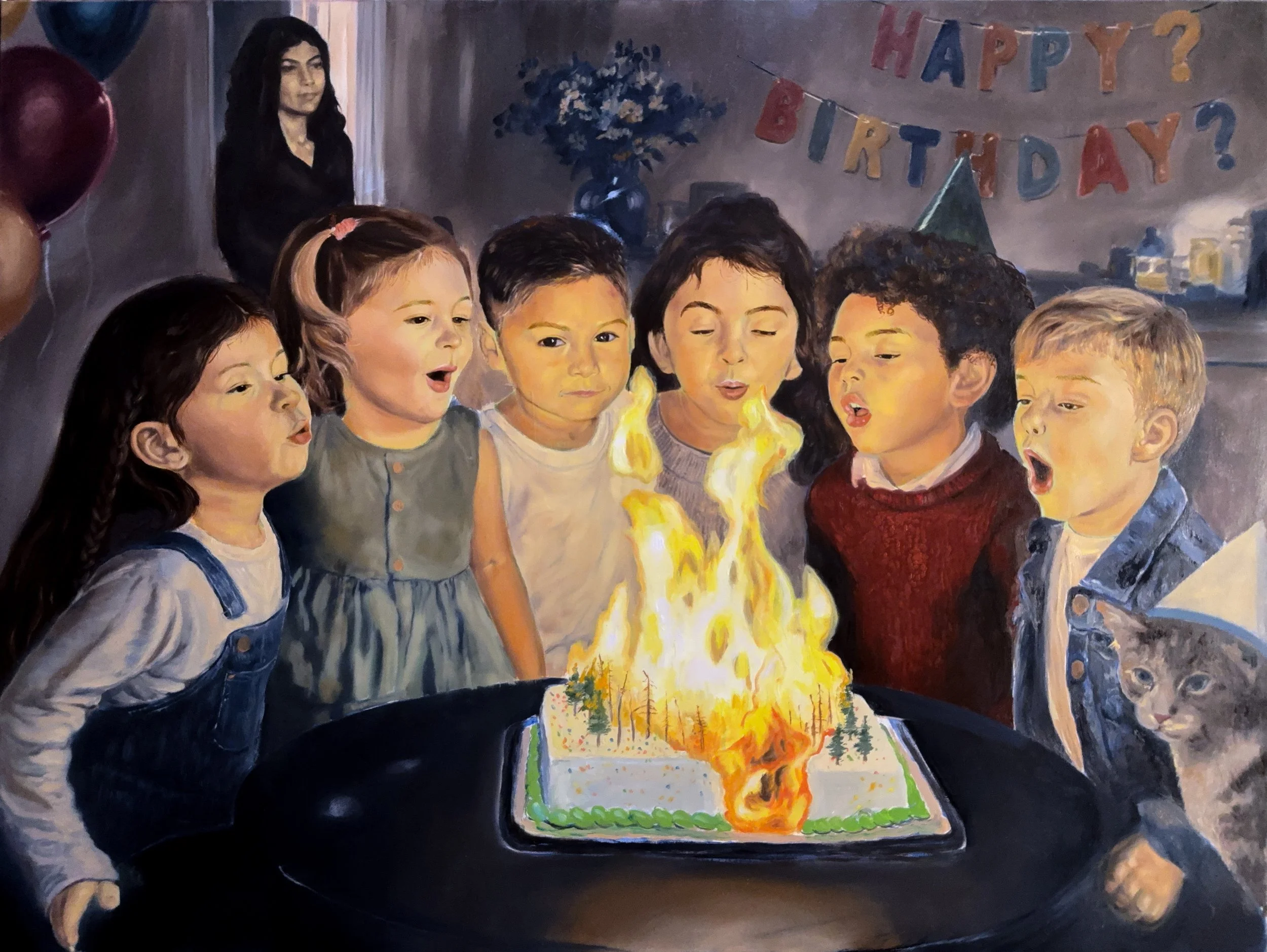
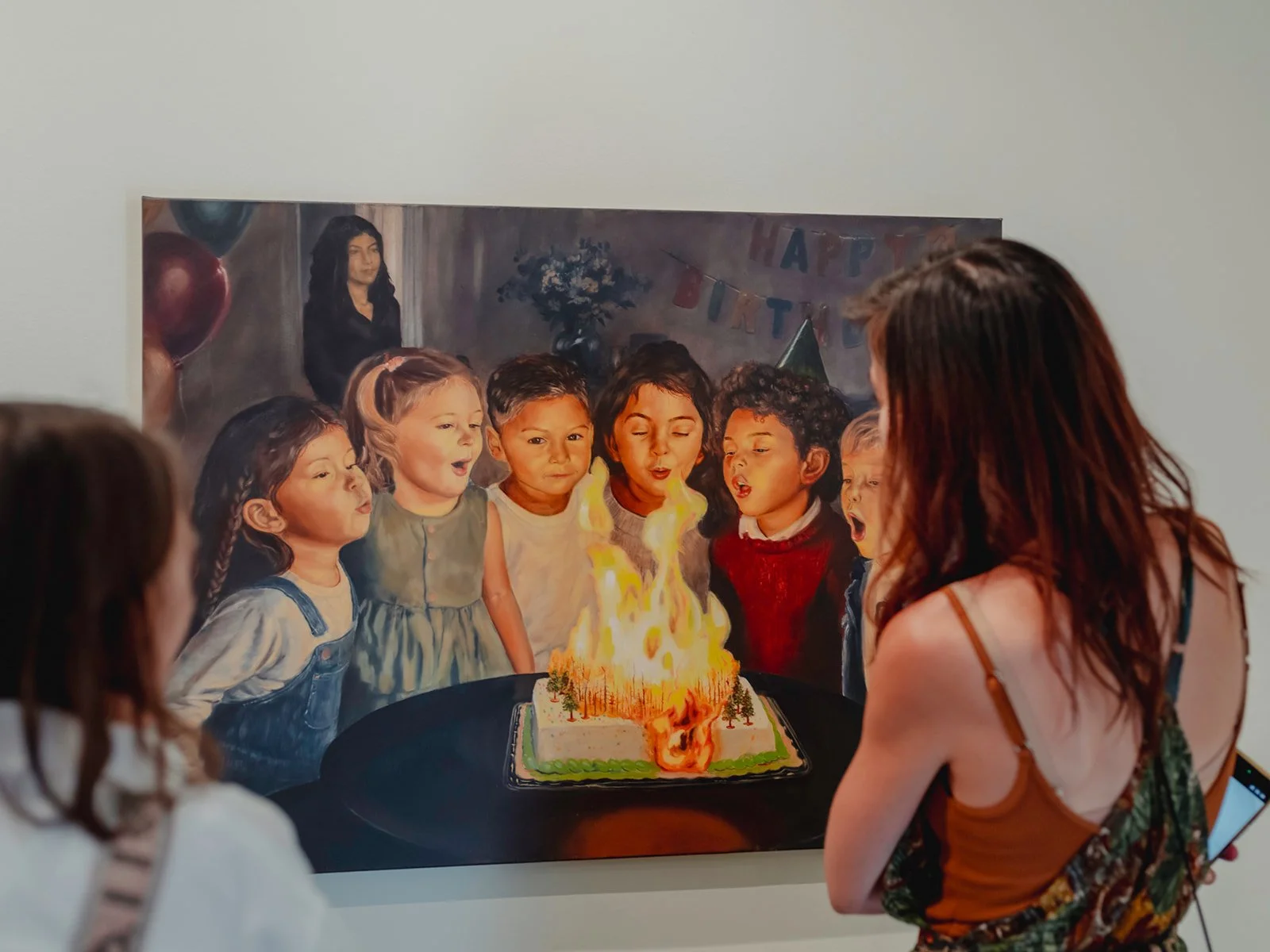
"I Used to Want to Save the World"
Oil on canvas
30 x40 in.
Artist Statement:
A birthday cake is a symbol of hope, growth, and the expectation of another year. It represents a future we often take for granted. In this painting, however, the cake is engulfed in flames as a group of children gathers around it, seemingly unaware of the danger before them. The future they are meant to inherit is already burning.
The work reflects the environmental legacy passed from one generation to the next. Today’s youth inherit a world increasingly shaped by climate change, biodiversity loss, and ecological disturbance. While they did not create these challenges, they are often expected to confront them and imagine solutions.
The title, I Used to Want to Save the World, speaks to a belief many of us shared as children when saving the world seemed possible for one individual. As we grow older, that optimism often collides with the realities of adulthood. Responsibilities accumulate, survival demands our attention, and our focus can gradually shift from saving the world to simply saving ourselves.
The painting does not criticize this change so much as question it. At what point do we stop believing the future is ours to protect? And if each of us becomes consumed by our own survival, who is left to care for the generations gathered around the cake?
While no individual can solve the environmental challenges we face alone, meaningful change has always depended on collective action. Perhaps the optimism of childhood was never naïve, but it simply misunderstood one thing: saving the world was never meant to be the work of one person.
Artist Bio:
Yhoshua Gutierrez is a self-taught artist based in Stockton, California. Working primarily in oil painting and drawing, his practice combines classical Renaissance techniques with contemporary portraiture and surreal imagery.
His work explores themes of identity, grief, and religious iconography, often inviting viewers into moments of quiet reflection and introspection.
Scientists Statement:
ECOLOGICAL INHERITANCE
(ee-koh-loj-i-kuhl in-hair-i-tuhns)
No generation begins with a blank slate.
In ecology, “ecological inheritance” describes the environmental conditions one generation leaves for those that follow. Organisms do not simply adapt to their surroundings; they also modify them. Those changes can persist, shaping the opportunities and constraints experienced by future generations.
Humans are particularly powerful participants in this process. The forests we inhabit today carry the accumulated effects of choices made long before many of us were born. Indigenous stewardship and cultural burning, industrial grazing, logging, fire suppression, development, and forest management have each left ecological legacies. Added to these is a warming climate driven by greenhouse gases accumulated over generations.
Some of these inheritances are visible: dense forests, altered streams, roads, burn scars, recovering vegetation. Others unfold slowly. Carbon dioxide can remain in the atmosphere for centuries, while changes in climate can influence drought, wildfire, species distributions, and forest regeneration far into the future.
Inheritance, however, is not destiny. The environmental conditions passed to the next generation constrain what is possible, but they do not determine a single outcome. Each generation encounters what came before and, through its own actions and decisions, modifies what comes next.
This creates a tension between individual and collective survival. An individual organism responds to the conditions immediately around it, but the persistence of a population, community, or ecosystem depends on processes operating beyond any one individual. Humans face a similar problem: choices that protect our immediate interests may not always protect the ecological systems on which we collectively—and future generations—depend.
Ecology also complicates the idea of “saving the world.” There is no single, fixed version of nature to preserve indefinitely. Ecosystems have always changed. But the pace and direction of that change matter. Our choices can preserve—or diminish—the capacity of future ecosystems to support diverse species, functioning ecological processes, and human communities.
A birthday marks both directions in time: another year inherited and another year anticipated. The children gathered around this cake inherit ecological conditions they did not choose. Their task will not be to restore some perfect world that existed before them, just as ours cannot be.
Perhaps “saving the world” means something less heroic and more collective: leaving those who come next a world with possibilities. Ecological inheritance reminds us that what one generation receives, it also alters—and eventually passes on.
PHOTOS BY ALEX CANCRO