Juanita Lavadie
Taos, New Mexico

"Surface Fire, Crown Fire, Soil, & Watershed"
22 x 10 in each
Textiles are woven on an 8-harness loom with Commercial wool yarn warp. The weft is commercial and handspun yarns, some vegetal dyed.
Artist Statement:
Forest Fires during the 2026 drought year are very much in the general scope of awareness. I have 2 tapestry panels that represent 2 types of forest fires, surface fire and crown fire.
When considering a healthy forest, there are specific considerations, soil and the watershed from storms over the mountain tops to aquifers underground, and the changes affected by human modern technology. The thin layer of topsoil is full of lifeforms critical to a healthy soil that will sustain trees, plants, and wildlife diversity of wildlife that contributes to the multitude of interdependent healthy life cycles.
5 identified extinction periods of our planet earth have been documented, from meteor impacts to volcanic eruptions that created a thick atmosphere over the earth, snuffing out sunlight and lifeforms as a result. The 6th potential extinction, Anthroposcene, has been a focus of research with current alarming rates of animal and plant species becoming extinct. This potential extinction is one created by human (anthopos) interference with natural cycles through mining, fracking, large-scale dams, cloud seeding, riverbed diversions, chemical pollution of water and atmosphere, depletion of natural resources and excessive dependency on petroleum, that triggers climate changes. I believe there is still hope in our human capacity for healing that has yet to manifest globally, and that there is still reprieve through awareness and by actions and work that healing needs.
Artist Bio:
Juanita J Lavadie is a native Taoseña, with intergenerational family ties on both sides of the Rio Grande in Northern New Mexico. She is a multi-media artist, an active acequia parciante and a retired public school educator. She works with oral history, fiber arts, graphic arts, book-making, music and dance to generate projects that reflect respect for cultural and ecological resilience.
Works reflect local and historically cultural concerns about issues with the health of the earth, water, atmosphere, and of the communities that thrive and flourish over generations on the earth as we arrive to the present. Work projects have a pedagogical start introducing concepts to encourage participation and dialogue. Traditional low-tech hand skills and tools through community collaborations and modern technology applications create works that aspire for stewardship awareness of critical natural resources available in these contemporary times.
Scientists Statement:
FUEL COMPLEX
(fyoo-uhl kom-pleks)
Fire does not burn a forest. It burns fuel.
Scientists use the term “fuel complex” to describe the amount, type, size, condition, and arrangement of combustible material in a landscape—from grasses and pine needles to shrubs, fallen branches, small trees, and the crowns of mature trees. The fuel complex helps determine how fire moves and behaves.
In dry conifer forests of the Southwest, frequent surface fires historically traveled through grasses and other fine fuels growing beneath widely spaced trees. These fires served to maintain balance and stabilize these ecosystems. But beginning in the late nineteenth century, industrialized intensive grazing by sheep and other livestock - made possible by the arrival of the railroad - removed much of that grassy fuel. With less fine fuel available to carry flames, stabilizing, low-severity fires became less frequent.
Over decades, the fuel complex changed. More young trees survived. Needles, branches, and woody debris accumulated. Logging, fire exclusion, and later fire suppression further transformed forest structure. In many places, open, grassy forests became denser and increasingly dominated by woody vegetation. By reducing grass cover and root systems, intensive grazing also altered soils, increasing erosion and compaction in some places and changing how water and nutrients moved through the ecosystem.
And with this shift in the fuel complex, we’ve seen a shift in the way fire behaves in these forests.
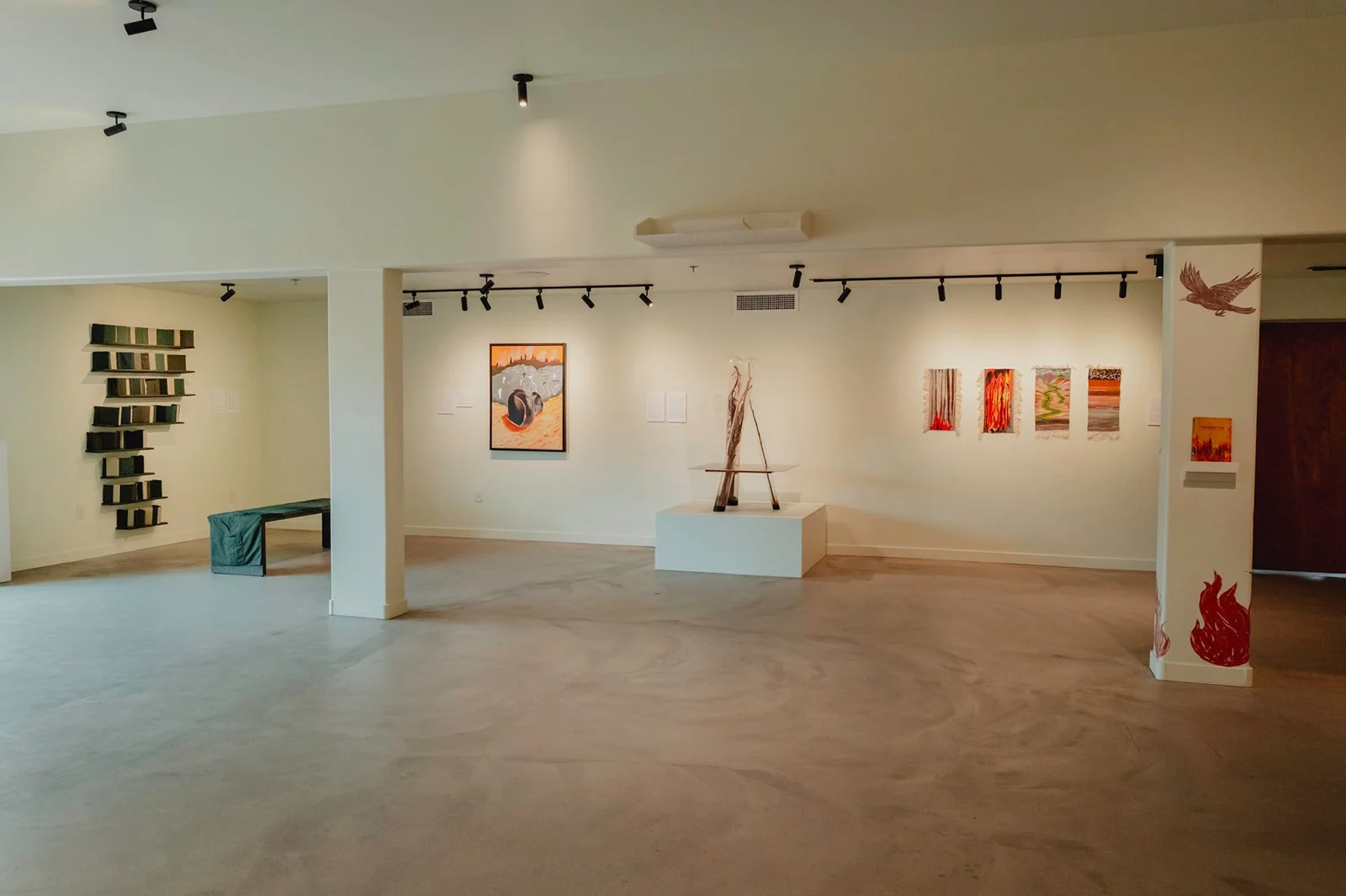
The contrast appears in these weavings: “Surface fire” depicts fire moving through a more open, grassy fuel complex, where flames remain largely on the forest floor. “Crown fire” depicts what can happen when abundant woody fuels allow fire to move upward and burn through the forest canopy. These crown fires, in turn, can have devastating consequences for the function of our watersheds in the arid Southwest.
The transformation in the fuel complex over the last century has also changed what human uses these landscapes can support. As grasses declined and dense trees and shrubs increased, some forests became less productive for livestock grazing—including the sheep whose wool has long supplied Northern New Mexico’s weaving traditions.
We shape the landscape, and the landscape shapes how we live within it.
PHOTOS BY ALEX CANCRO